
Do not buy a geyser timer from the tank size printed on the side.
A 150 litre cylinder can have a 2 kW, 3 kW or 4 kW element. The switch only cares about amps. Amps come from the element stamp, usually on a small plate near the thermostat: 2000W, 3000W, 4000W.
At 230 V:
- 2 kW ≈ 8.7 A
- 3 kW ≈ 13 A
- 4 kW ≈ 17.4 A
That is why the default Sonoff in a South African geyser cupboard is the 20 A POW Elite, not a R180 Basic relay, and not whatever 16 A switch happened to be on special.
The short answer
| Element on the plate | What we put on it | Why |
|---|---|---|
| 2 kW | POW Origin 16A | Headroom is fine. Cheaper. Still meters power. |
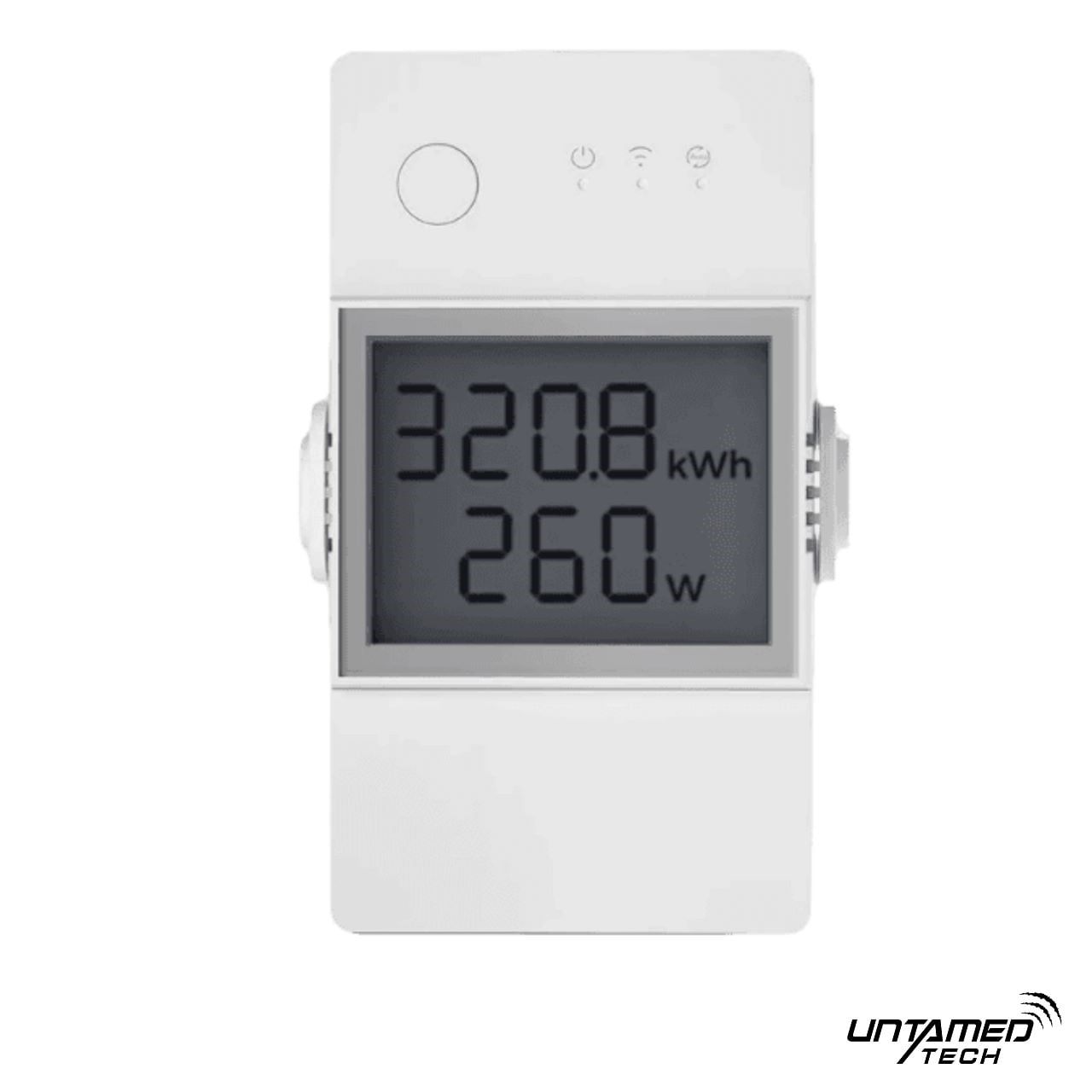
| 3 kW (most suburban tanks) | POW Elite 20A / POWR320D | This is the one. LCD, 20 A, built for geyser/pool. |
| 4 kW or “I cannot read the plate” | 1P 63A DIN-rail geyser breaker or a contactor + meter | Do not squeeze a 4 kW element through a 20 A inline body and hope. |
| Heat pump / unknown modern unit | Stop and send us a photo | Different current, often a different control circuit. |
Prices as of September 2026 on the shop: Origin R349, Elite and the 63 A breaker R399. Check the product page before you order.
If you only read one line: 3 kW element → POW Elite 20A.
How to read the plate without guessing
- Isolate the geyser at the isolator. Not at the app. At the isolator.
- Look at the element plate or the thermostat cover. You want watts, not litres.
- If the cupboard is a graveyard of insulation and the plate is unreadable, treat it as 3 kW or higher and do not cheap out.
- Look at the existing isolator rating. A 20 A isolator feeding a 4 kW element is already a story.
Litres only tell you how long the water stays hot. They do not tell you what the element pulls when it sits on.
POW Elite 20A — the default
The Sonoff POW Elite 20A (POWR320D) is the unit we sell into most geyser jobs.
What it actually gives you:
- 20 A ceiling, which covers a 3 kW element with room
- A small LCD so you can see watts without opening the app
- Schedules in eWeLink so the geyser is not sitting on from 10:00 to 16:00 for nobody
- Power history, which is how you catch a thermostat that never opens
- Overload cut-off if you set it
What it does not give you:
- A free pass to skip the isolator
- Magic savings if the house already runs the geyser two hours a day
- A local Home Assistant setup on its own — that comes later
It needs a neutral and 2.4 GHz Wi‑Fi. Geyser cupboards are often a dead zone. If the phone can barely load WhatsApp next to the tank, fix signal before you blame the Sonoff.
POW Origin 16A — only if the element is 2 kW
The POW Origin 16A meters power and costs a bit less. It is the right box for a genuine 2 kW element.
It is the wrong box for a 3 kW element that “should be fine because 13 A is under 16 A.” Voltage dips, a tired thermostat, and a warm cupboard all eat that margin. Buy the 20 A unit.
The Origin page itself points you at the Elite for larger loads. Listen to it.
The 63 A DIN breaker — when the tank is bigger, or you want it in the DB
The 1P 63A Wi‑Fi geyser breaker sits on a DIN rail. Rated 40 A continuous / 63 A peak. Same eWeLink schedules and monitoring idea, different body.
Use this path when:
- The element is 4 kW
- You would rather switch the circuit in the DB than hang a plastic box in a damp cupboard
- The electrician is already in the board
This is not a DIY first project. Neutral required. Board work is an electrician job.
What not to put on a geyser
These are good products. They are not geyser products.
- Sonoff Basic / Mini R4 — fine for a gate light. Not fine for a 3 kW element.
- Dual R3 — two channels, lower per-channel rating. Wrong tool.
- Any plug-in smart plug — do not put a geyser on a wall socket adapter and call it automation.
- TH Elite as your only plan — useful later if you add a probe and want temperature logic. It is not the default timer.
If a YouTube short shows a Basic relay on a geyser, close it.
Where the box actually lives
Geyser cupboards in this country are hot, dusty, and sometimes wet.
- Keep the isolator. The Sonoff is extra control, not a replacement for the isolator.
- Use a waterproof box if the unit sits near the tray or in a roof space that leaks.
- Do not bury it in insulation.
- Strain-relief the cables. A hanging POW on two thin tails is how terminals cook.
If that paragraph already makes you uncomfortable, send photos and let an electrician do the line side. We install in Gauteng. Details are on the about page.
Load shedding and solar, without the brochure language
A timer in the device still runs its schedule when the cloud is moody, as long as the unit has power and has already been set.
What fails:
- Router dies in Stage 4, so you cannot change the schedule from the office
- Inverter is carrying the geyser and the battery falls over by 19:00
- You “save power” by running the geyser at 17:00, which is also Eskom peak and also when everyone else comes home
Simple starting schedule we use a lot:
- Heat before the morning rush
- Off while the house is empty
- Short top-up before evening showers
- Stay off during known load-shedding windows if that circuit is on backup you cannot spare
Home Assistant can read the inverter and Eskom calendars later. Do not wait for that before you put a timer on a geyser that currently runs 24/7. That first step is in how to start a smart home in South Africa.
What this does to the bill
If the element was on all day, a timer usually pays for itself in weeks, not years. If you already switch it at the isolator like a hawk, the win is smaller: you get remote control, a log, and you stop arguing about who left it on.
We will not print a fake “save 60%” number on a house we have not seen. Look at the LCD for a week. The watts do not lie.
Buy path
- Read the element stamp.
- Pick Elite, Origin, or the DIN breaker from the table above.
- Order from the power monitoring or Sonoff shelves.
- If the cupboard or the DB looks messy, WhatsApp photos before you open it.
You do not need a luxury automation quote to stop paying for hot water nobody is using.
FAQ
Is the POW Elite safe on a 3 kW geyser? Yes, if it is wired on the load side of a proper isolator, the terminals are tight, and the unit is not cooked in insulation. 3 kW at 230 V is about 13 A. 20 A is the point of that model.
Can I use a 16 A Origin on a 3 kW element? We don’t. The maths looks close. Cupboards are not a lab. Buy the 20 A Elite.
Do I need an electrician? If you are going into the DB, onto the isolator tails, or you cannot find the element rating, yes. Pairing the app is the easy part.
Will it work during load shedding? The switch only works if that circuit still has power. The app only works if the router is up. Put the router on a small UPS if you want to change schedules during an outage.
Can Home Assistant take over later? Yes. Get the circuit switching reliably first. Then bring it into Home Assistant. Do not start with YAML on a geyser that has no isolator. See Home Assistant in South Africa.
What if I have a heat pump geyser? Send the model photo. Many heat pumps are not a simple 3 kW resistive element and should not be treated like one.